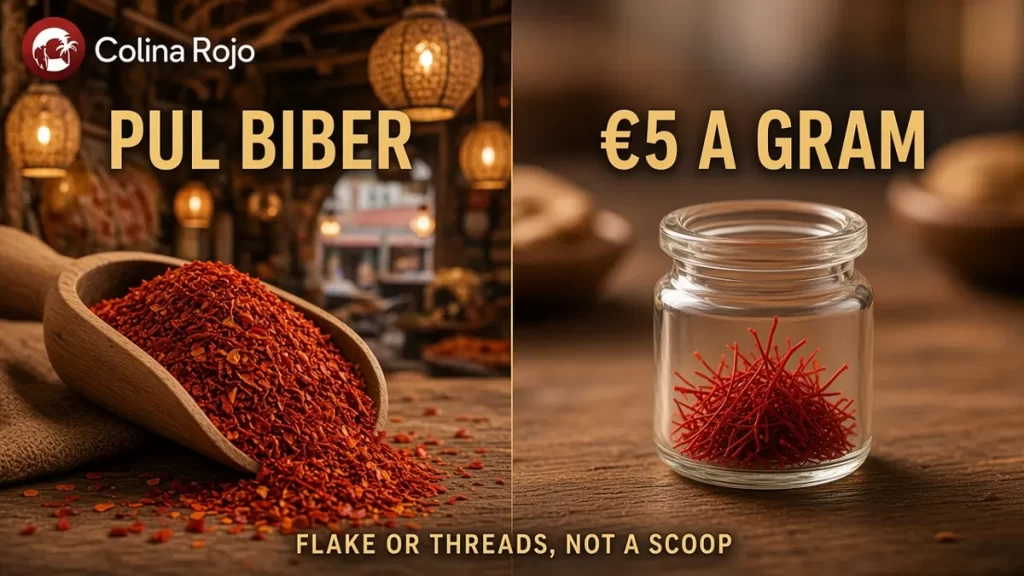
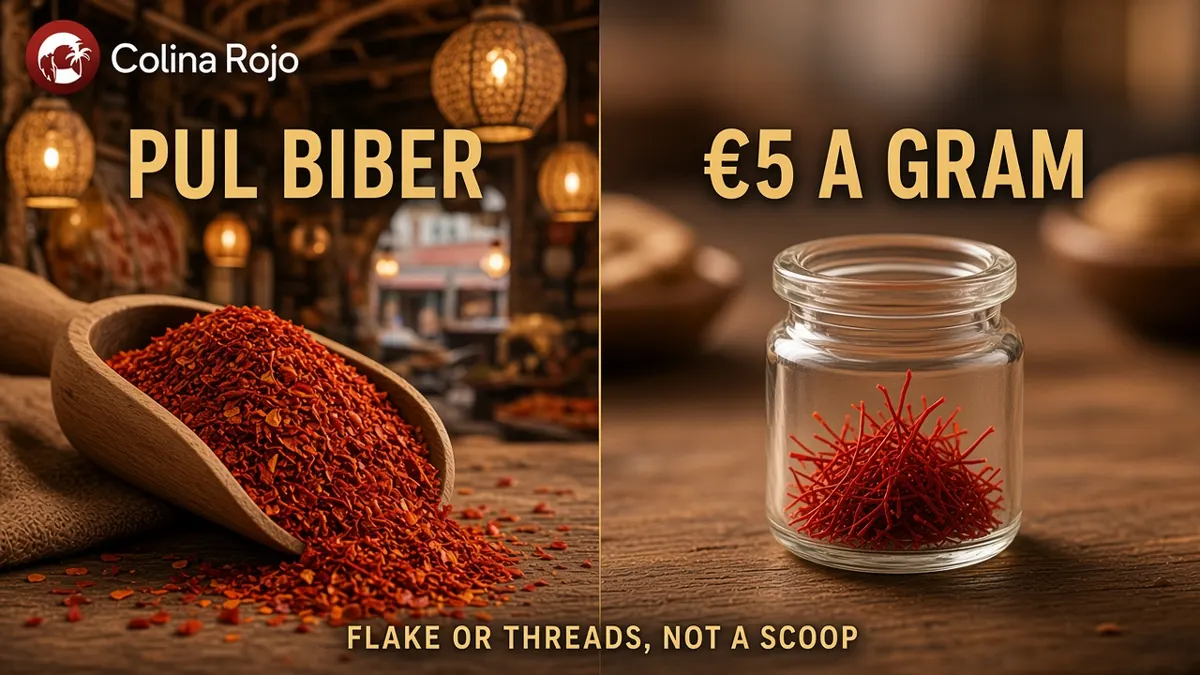
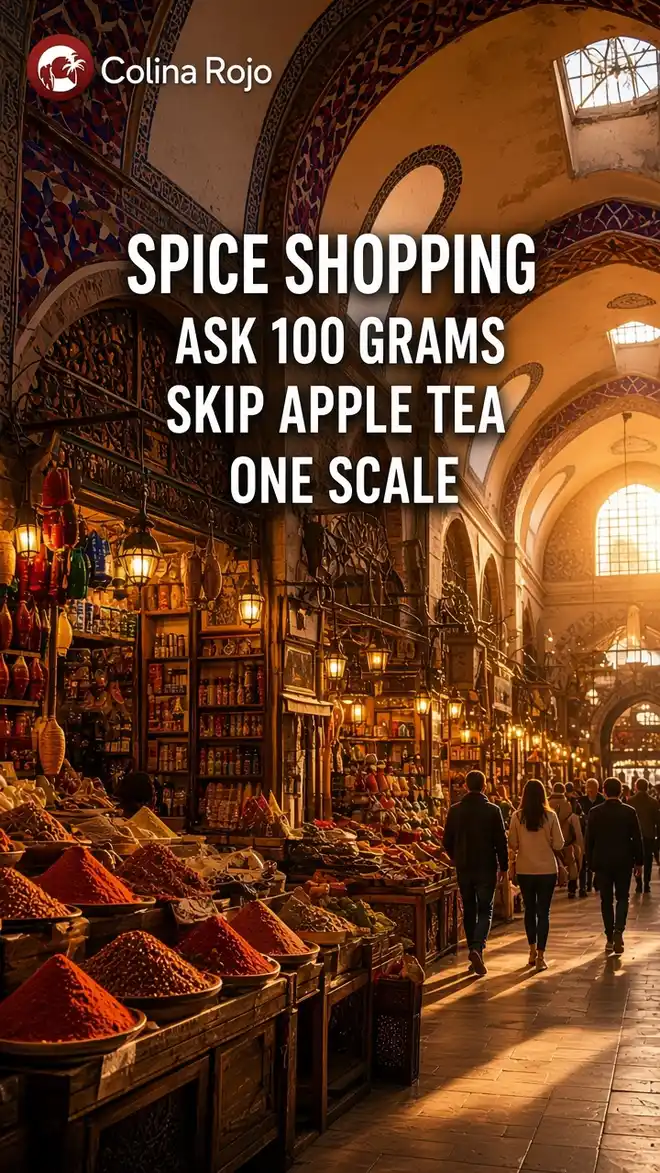
Istanbul spice shopping is three jars: pul biber, isot, and sumac. Ask the price for 100 grams before the scoop. Real saffron is threads, about 5 to 10 euros a gram. Skip apple tea crystals.
Istanbul spice shopping starts with three jars: pul biber, isot, and sumac, 50 to 100 grams each. Ask the price for 100 grams before the scoop moves. Real saffron is threads, about 5 to 10 euros a gram. A scoop at a paprika price is safflower, not saffron. Apple-tea crystals are sugar, not tea. Lokum is worth buying after you taste the piece and see real pistachio. The hall behind the New Mosque is free. Its own page says 10:00 to 20:00, seven days. A morning voucher does not include this shop. Colina Rojo Travel, TÜRSAB 16602.
Istanbul spice shopping is a 100-gram decision, not a kilo of red powder. Buy pul biber, isot, and sumac. Skip apple-tea crystals and any saffron sold by the scoop. Real threads run about 5 to 10 euros a gram. Pul biber in the hall is often about 3 to 5 euros per 100 grams once you have heard the price. Ask before the scoop moves. The hall is free, behind the New Mosque at Eminönü, and the bazaar’s own page says 10:00 to 20:00, seven days. A morning voucher does not include this shop. Colina Rojo Travel, TÜRSAB 16602.
Contents
- What to take home
- Pul biber, isot, sumac
- The saffron test
- Lokum, tea, coffee
- What the numbers mean
- How to bargain
- Scale, card, suitcase
- Where it sits on the day
- Buys we would make
- Twelve checks before you pay
- Common questions
Istanbul spice shopping worth carrying
An istanbul spice shopping list that starts with “a bit of everything” comes home as salt and sugar. Name three jars before you walk in. The door, the Sunday, and the 45-minute clock are already on our Spice Bazaar Istanbul page. This page is the bag. The partner version of that door page is the Hagia Sophia Travel spice hall. One hall, two write-ups, no second building.
| Take | Leave |
|---|---|
| Pul biber, isot, sumac, kekik, mint, cumin | A kilo of unnamed red powder |
| Saffron threads in a small sealed jar | A scoop priced like paprika |
| Lokum you tasted, cut in front of you | Apple-tea crystals sold as fruit |
| Loose black tea or dried mint | A blend with no ingredients on the bag |
Hours move on holidays. The board we trust is the Mısır Çarşısı FAQ: seven days, 10:00 to 20:00, with changes posted there. Recheck the week you fly. Grand Bazaar Sunday closure does not apply to this hall.
The three jars that earn the suitcase
Pul biber is the flake on an Istanbul breakfast plate. Maras style is bright red, fruity, and warm rather than a dare. Smell it. Dusty and flat means it has sat. An istanbul spice shopping stop that buys only this jar has already done the useful thing. About 3 to 5 euros per 100 grams in the hall is the band we still see once the price is said out loud. A labeled jar in a supermarket such as Migros is the comparison. More than about double that jar, for the same named flake, is a walk.
Isot is the other pepper, from Urfa. It is darker, often a little oily, smoky, and less sharp. People call both “chilli” and then wonder why the eggs taste different. Ask which one is in the scoop. Isot usually costs a little more than pul biber. If the jar is pale and bone-dry, it is old. The oil is part of the product, and it stains a white shirt.
Sumac is the tart purple-red on onions and grilled meat. It should smell lemony, not like old cardboard. Brown dust is often stale, or salt dressed up as fruit. An istanbul spice shopping bag with sumac, pul biber, and isot covers the table most guests actually cook. Kekik (the wild oregano-thyme), dried mint, and cumin are the next three if the suitcase still has room. Fifty to 100 grams of each is a year of home cooking. A kilo is a customs question and a heavy bag.
Threads, or the red that is not saffron
Real saffron is the dried stigma of a crocus. It is sold by the gram, in threads, usually in a tiny sealed jar. About 5 to 10 euros a gram is the honest band in this city. A mountain of bright orange “Turkish saffron” at a paprika price is almost always safflower, the seed Turks call aspir, or dyed fibre. It is pretty. It is not the spice you meant.
The water test takes ten minutes and a glass you can see through. A real thread turns the water gold slowly and keeps its shape. A dyed piece dumps brick-red colour at once and goes limp. Smell is the other check: hay and honey, not nothing. An istanbul spice shopping decision on saffron is threads or nothing. Powder in an unmarked tin fails the test before you open it, because you cannot see a thread.
Iranian threads are what most honest counters sell, and they will say so. A shop that refuses the origin, or that keeps the “saffron” in an open basin next to the paprika, is selling colour. Buy one gram if you cook with it. Do not buy 50 grams because the tin is pretty. You will not use it, and you probably did not buy saffron.

Sweets and tea are a different purchase
Lokum is not a spice, and it is still the buy the hall is good at. Eat the piece they cut. Then name the box: pistachio, rose, or plain. Pistachio should look like nuts. A uniform green paste is colour. A mixed kilo often lands around 12 to 25 euros depending on the nut and the shop. An istanbul spice shopping trip that spends the whole budget on three kilos of lokum has skipped the jars that survive a year in a cupboard.
Apple tea in crystals is sugar, acid, colour, and a flavour. The sample in a tulip glass is sweet on purpose. Buy one small tin if you want the souvenir. Do not buy it as tea. The glass the city drinks is black tea. Loose Rize tea, or dried mint for nane çayı, is the honest leaf. Dried apple pieces, if the shop will show you the fruit, are a different product from the crystals.
Turkish coffee is a counter just outside the hall, on Tahmis, at Kurukahveci Mehmet Efendi. The price is on the board. The queue moves. That stop is coffee, not a place to test saffron. Pomegranate molasses is worth it only if the label is pomegranate, not glucose and citric acid. The bottle is glass. Glass and a full suitcase is how a jar breaks on the tram.
Read the band, then the scale
These are late-2026 bands we still quote after the price is spoken, in euros, before VAT is even a thought because this is a shop not a tour. The lira figure on the scale is the one you pay. It moves. Two shops on the same morning can differ. An istanbul spice shopping note on your phone, written after the first stall, beats a blog number from last spring.
| Item | Band we still see | The fail |
|---|---|---|
| Pul biber, 100 g | About 3 to 5 euros | Double a labeled supermarket jar |
| Sumac, 100 g | About 2 to 4 euros | Brown dust, no smell |
| Isot, 100 g | A step above pul biber | Sold as the same flake |
| Cumin, 100 g | About 2 to 3 euros | A mix you did not name |
| Saffron, 1 g threads | About 5 to 10 euros | A scoop at paprika money |
| Lokum, mixed kilo | About 12 to 25 euros | Green paste called pistachio |
The streets just outside the arch, including Hasırcılar, sell the same named flakes, sometimes for less. The saffron test does not relax out there. An istanbul spice shopping rule that says “inside is always a trap” is as wrong as “inside is always fair.” Price one jar in the hall and one jar outside before you fill a bag. Rent is in the pretty arches. So is the crowd.
Bargaining is a sentence, not a show
Hear the price for 100 grams before anyone moves a scoop. That is the whole game. A posted price per kilo is a calmer shop than a whisper. An istanbul spice shopping haggle that opens at half the first number is carpet-shop theatre, and the jar you get is often the tired one. On a large mix, a small courtesy is normal. If the shop next door is far cheaper for the same name, leave. You do not owe the tea.
Tea is hospitality until the bag is already twisted shut. You can still say no. “Special price because you are my friend” after a camera comes out is the standard price. Pay in lira. If the card terminal offers to charge euros, decline the conversion and ask for lira. Cash euros at a rate you did not write down is how a 4 euro jar becomes 9. We do not take a commission from a stall, and we do not walk you to an uncle.
Watch the scale and the label
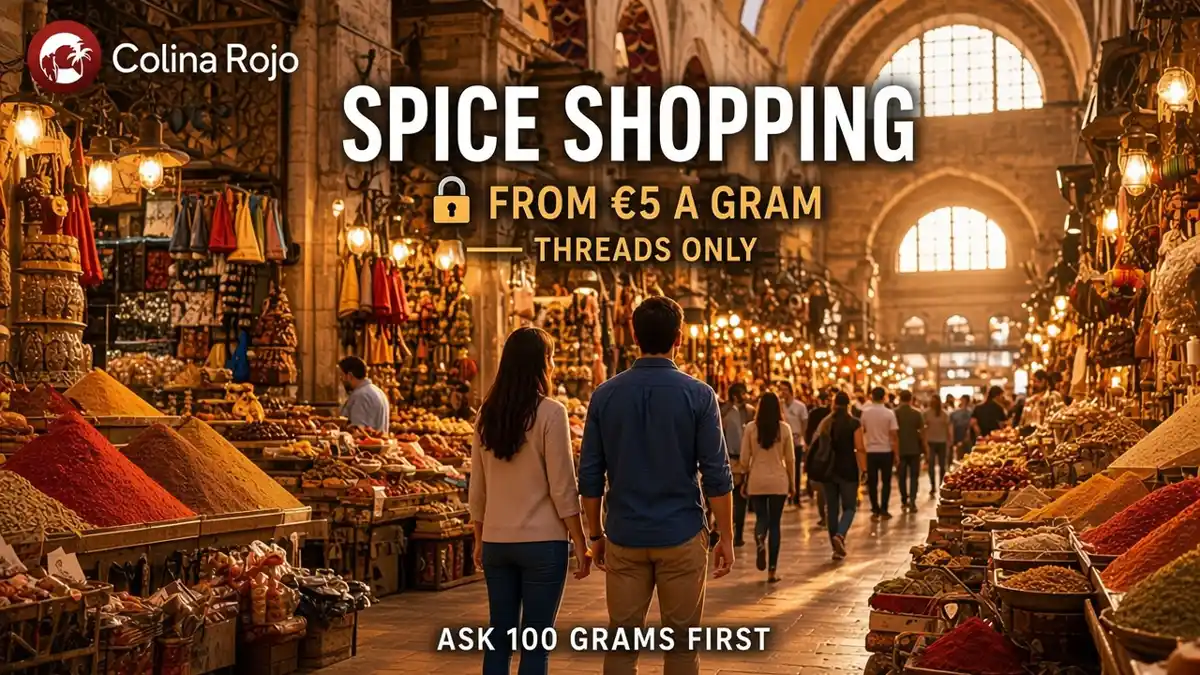
Point at the jar you tasted. Watch that jar go on the scale. An istanbul spice shopping bag filled from a different sack is a different product. Say the grams out loud. 100 grams is 100 grams. A smile is not a receipt. Ask for the name on a sticker: pul biber, isot, sumak, kekik. A blend called Ottoman, with no ingredients, is salt and colour until proven otherwise.
Zip the daypack before you enter the corridor. Phone in a front pocket. The square outside, by the mosque and the tram, is busier than the hall. Nuts in lokum matter if someone in the party cannot eat them. Isot oil heats and stains. Sumac is tart, not mild paprika, if a child dumps it on eggs. Personal amounts of dried spice in a closed bag are the normal souvenir. Your own border decides the kilo. Recheck that rule before you pack a suitcase of jars.
The voucher and the shop are different
The private morning, from 125 euros, 08:00 to 13:00, is the morning half day. Gallery included, no van, meet in Sultanahmet. It does not also hold a calm shop in Eminönü. The standard day, from 230 euros, is the standard full day, with the van and lunch. That day holds the Grand Bazaar when the Grand Bazaar is open. It is not this shopping list. Sunday, Beyazıt is shut and this hall is the covered market still trading.
The day that does walk the Spice Bazaar is the full day in Spanish, from 100 euros, 08:30 to 17:00, maximum 15. The guide is Spanish-speaking. Shopping stays your money. The gallery on that page is optional at 25 euros on site. If you want this hall as its own 45-minute block on a private day, put it on the planner. The guide fee is 150 euros once per booking. The ready-made cancel line is not a promise on that screen.
From a Sultanahmet hotel the walk downhill is about 20 to 30 minutes. The walk back up is the slow one. Istanbul Airport is 48 km, 45 to 60 minutes, 45 euros for the vehicle, up to 6 passengers and 6 bags, Gate 9, point CEO 34. Sabiha Gökçen is 65 km, 75 to 95 minutes, 50 euros, pillar 10. Book Istanbul Airport to Sultanahmet and the return on Sultanahmet to Istanbul Airport. A same-morning landing is a hotel, not a stall.
Five buys, with the number said first
Buy one: 100 grams of pul biber after you smell it, price said first, about 3 to 5 euros. An istanbul spice shopping trip can stop there and still have cooked a better breakfast than the apple tea.
Buy two: the same weight of isot, named out loud so it is not the flake you just bought. Darker, a little oil, a step more money. Taste a grain. If it is only harsh heat and no smoke, it is the wrong jar.
Buy three: sumac that smells like lemon. Skip the brown tub. An istanbul spice shopping guest who adds this to onions understands the kebab plate they ate yesterday.
Buy four: one gram of threads, or zero saffron. Not the basin. The water test if you are unsure. About 5 to 10 euros. If the shop will not let you see a thread, you are finished with that counter.
Buy five: one box of lokum you tasted, not three kilos. Pistachio that looks like pistachio. Then leave. An istanbul spice shopping hour past that is how the suitcase fills with tins you will not open. Mehmet Efendi for coffee on the way out if the queue is short. Black tea if you want tea. Crystals only as a joke you understand.
A family of four does not need four kilos. One shared set of three jars and one lokum box feeds the story. Children still eat the sample. Nuts still count. An istanbul spice shopping budget of about 20 to 40 euros covers a serious bag for two adults if saffron stays at one gram. A 100 euro “mix for your kitchen” offered after tea is the number to refuse.
Twelve checks before you pay
Check the name. An istanbul spice shopping sticker should say pul biber, isot, or sumak, not “special mix.” If the seller cannot say the Turkish word, you are not buying the jar you think.
Check the smell with the lid off, close to the jar, not across the corridor. An istanbul spice shopping nose is faster than the story. Pul biber is fruity. Sumac is tart. Nothing is nothing.
Check 100 grams on the scale while you watch. An istanbul spice shopping weight you did not see is a weight you can refuse. The bag can be emptied back into the jar.
Check a second stall for the same name before the first bag is shut. An istanbul spice shopping gap of double the money, same flake, is your answer. Thank them. Walk twenty metres.
Check saffron as threads only. An istanbul spice shopping gram at about 5 to 10 euros can be real. A scoop at the price of pul biber cannot. Use the warm-water glass if the shop will spare one thread.
Check lokum with your teeth, then the nuts. An istanbul spice shopping box of green paste is colour. Pistachio pieces look irregular. Rose should smell like rose, not like soap.
Check the tea tin for the word crystal, powder, or instant. An istanbul spice shopping tin of apple tea is a sweet. Loose leaf is the tea. Buy the one you meant.
Check the card screen for TRY. An istanbul spice shopping charge that flips to euros on the terminal is a second price. Cancel and pay lira, or leave.
Check the street price on Hasırcılar only after you have one number from inside. An istanbul spice shopping comparison works in that order. The outside stall still owes you the same smell and the same scale.
Check the suitcase before the kilo. An istanbul spice shopping jar of 100 grams survives a flight. Six kilos of cones do not, and your border may not want them. Personal amounts, closed bags, names you can read.
Check the guide’s hands. An istanbul spice shopping stop on our day is advice, not a door we are paid to open. If another tour’s every sample is the same uncle, finish the tea and choose your own stall.
Check the clock. An istanbul spice shopping visit that started as 45 minutes and became a second lunch has missed the pickup. Buy the three jars. Leave the cones for the photograph.
Common questions
What should istanbul spice shopping start with?
Pul biber, isot, and sumac, 50 to 100 grams each. Price for 100 grams before the scoop. Then stop.
How do I know the saffron is real?
Threads, about 5 to 10 euros a gram, gold colour in warm water over about ten minutes. An istanbul spice shopping scoop that turns the water red at once is not saffron.
Is apple tea worth buying?
As a sweet souvenir tin, if you like the tin. As tea, no. An istanbul spice shopping leaf is loose black tea or dried mint.
Should I bargain hard?
Hear the 100-gram price first. An istanbul spice shopping comparison is two shops. A small courtesy on a large mix is normal. Opening at half is the wrong room.
Is the morning tour the shopping time?
No. An istanbul spice shopping hour is not inside the 125 euro morning. That morning is Sultanahmet. The Spanish full day from 100 euros walks this hall. Shopping is still your money.
Does the standard day include this hall?
It includes the Grand Bazaar when that bazaar is open. An istanbul spice shopping hall is a separate block. Say the door when you book.
Can I pay in euros?
Pay in lira. Decline a card terminal that wants to convert to euros. Write the rate down if you insist on cash euros.
How much should I carry?
About 20 to 40 euros buys the three jars, a small lokum box, and one gram of real threads if you want them. A kilo of each spice is the bag you will regret at the airport.
Name the jar, hear the 100 grams, and leave while the suitcase is still a suitcase. The hall clock sits on the visit page. The odd private block sits on the planner, with the arrival and the return already saved.